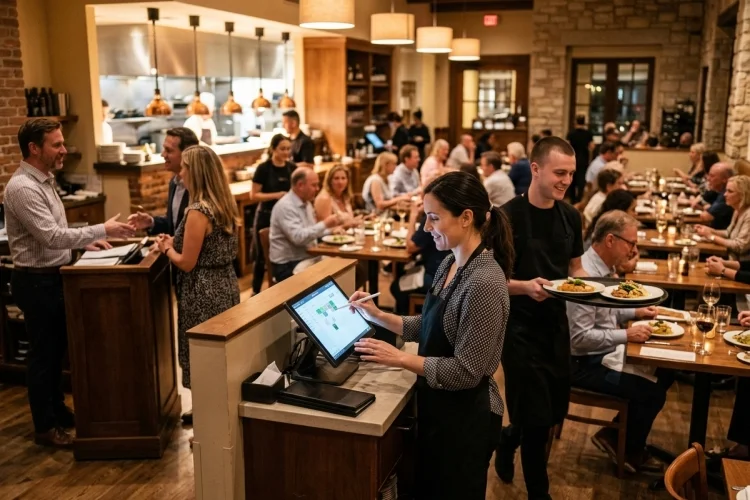
The dinner rush rarely fails because every part of a restaurant suddenly becomes inefficient. Usually, one part reaches its limit first.
The grill gets buried, drinks pile up at the bar, expo cannot coordinate plates, or servers wait behind one crowded POS station. Everything behind that constraint then starts slowing down.
How Restaurants Reduce Service Bottlenecks during peak periods comes down to finding these pressure points early and redistributing demand, labor, and information before queues become unmanageable.
The best solutions increase speed behind the scenes while keeping service calm and consistent for guests.
Find the Real Constraint, Not the Most Visible Problem
When twenty orders are late, the kitchen often receives the blame.
But the kitchen itself is a chain of smaller systems.
Orders move from POS to prep stations, cooking equipment, plating, expo, runners, and eventually the table. One weak point can restrict everything else.
Suppose the grill produces 60 dishes per hour, the sauté station handles 70, and cold production handles 80.
If expo can coordinate only 50 completed plates per hour, expo-not cooking-is the real bottleneck.
Operators should observe where work starts accumulating.
Look for stacks of tickets, food waiting under heat lamps, drinks sitting at the bar, employees waiting for equipment, or servers queuing for payment terminals.
The goal is to find the point where incoming demand consistently exceeds processing capacity.
Fixing that constraint can improve the entire restuarant without adding resources everywhere.
Use Ticket Data to See Kitchen Pressure Earlier
Average ticket time is useful, but it often tells managers that something went wrong after the delay has already happened.
Queue depth provides earlier information.
If the grill normally has eight open items but suddenly shows 28, managers can see pressure building before every ticket becomes late.
Kitchen display systems can make this easier.
Toast’s current KDS platform routes orders directly from POS systems to relevant kitchen screens and provides performance reporting that can help operators track preparation times and identify bottlenecks during peak hours.
Digital routing is particularly useful in multi-station kitchens.
Grill cooks can receive grill items, cold stations can see their own preparation requirements, and expo can monitor how those individual components come together.
Toast also notes that configurable KDS workflows can support different stations, menus, and service models.
Better visiblity does not eliminate kitchen pressure, but it gives managers more time to respond.
Balance Menu Demand Across Kitchen Stations
Sometimes the menu creates the bottleneck.
Imagine a restaurant’s six most popular entrées all depend heavily on the grill.
Demand might be strong and every dish may generate healthy contribution margin, but the production mix is unbalanced.
During peak service, guests effectively compete for the same piece of equipment.
Operators can reduce this concentration through menu design.
A high-margin roasted entrée using available oven capacity can receive stronger placement. Servers can recommend dishes produced by less-congested stations when the grill is already heavily loaded.
Recipes can also be redesigned.
A component currently finished on the grill might move to another method without changing the overall guest experience.
Toast’s 2026 restaurant-kitchen guidance emphasizes designing kitchens around the menu, service model, and team rather than assuming that a larger kitchen alone produces better efficiency.
Capacity planning and menu planning should therefore happen together.
Schedule People Where Queues Actually Form
Adding another employee somewhere in the restaurant does not necessarily improve service.
The additional labor needs to support the constraint.
If drink tickets are delayed, adding a bartender may be valuable. If tables remain dirty after guests leave, another busser or stronger cross-training could produce more capacity than another server.
Operators should forecast staffing by demand window and role.
7shifts recommends building schedules around historical sales and concentrating staffing around actual peak periods instead of distributing labor evenly throughout the day.
The same approach works at station level.
For example, historical POS data may show that between 7:00 and 8:30 p.m., cocktail sales double while food orders rise only 25%.
That period needs additional bar capacity rather than simply more floor staff.
Cross-training can create even more flexibility.
A food runner who can help expo or a host trained to support resets can move toward the queue as conditions change.
This kind of flexible deployment is often more useful than static schedulling.
Reduce Order-Entry and Communication Delays
Restaurants lose minutes whenever information waits.
A server writes an order, serves another table, walks to the POS, waits behind a colleague, enters the ticket, and finally sends it to the kitchen.
The guest may already have been waiting several minutes before cooking even begins.
Toast’s recent guidance on handheld POS systems explains how repeated trips to fixed terminals can create congestion during busy periods and delay orders reaching the kitchen.
Entering orders tableside can shorten this information gap.
The same principle applies between kitchen and floor.
When food is ready, servers or runners need to know quickly. When an item is unavailable, employees should not continue ordering it for another fifteen minutes.
Efficient operations shorten the time between decision and communication.
That is usually safer than trying to shorten cooking times beyond what quality allows.
The fastest restaurant is often the one where information moves quickly, not where employees physically run faster.
Protect Labor Productivity Without Creating New Bottlenecks
Restaurant operators face legitimate pressure to control labor.
National Restaurant Association data based on 2024 operations showed that salaries and wages including benefits represented a median 36.5% of sales at full-service restaurants, while profitable full-service respondents reported a lower 34.2% median.
That does not mean reducing staff always improves profitability.
Suppose removing one food runner saves $100 during dinner.
Without that runner, servers spend more time collecting plates, expo becomes crowded, food sits longer, and table resets slow down. If the restaurant loses several covers or creates more comps, the $100 saving may be expensive.
Sales per labor hour can help identify whether labor is productive.
7shifts defines SPLH as sales divided by labor hours and notes that unusually high numbers may actually indicate understaffing and declining service quality.
Strong operators therefore optimize labor against throughput and guest outcomes rather than minimizing payroll blindly.
Create Peak-Service Operating Rules
When demand rises rapidly, teams should already know what changes.
Waiting until the restaurant is overwhelmed to invent a solution wastes valuable time.
Operators can establish trigger points.
For example, if grill queue depth exceeds 20 items, one cross-trained cook moves to support the station. If average ticket time exceeds 22 minutes, hosts temporarily reduce walk-in seating pace.
If the cocktail bar becomes overloaded, servers may shift recommendations toward wine, beer, or simpler drinks where appropriate.
These rules should not be rigid enough to replace management judgment. They simply create a prepared response to predictable problems.
OpenTable is also developing automated reservation pacing designed to space reservations and create steadier guest flow between the dining room and kitchen.
Whether the restaurant uses advanced technology or a basic manual system, the principle is the same: smooth arrivals before demand becomes a wave.
Measure Recovery as Well as Average Performance
Averages can hide chaotic periods.
A restaurant might report an average ticket time of 16 minutes for the evening, yet spend 30 minutes at 8 p.m. with tickets exceeding 28 minutes.
That peak period is where guests experience the operation.
Managers should therefore track both average performance and worst-period performance.
Useful measures include peak ticket time, longest queue, time required to clear a backlog, order errors, comps, table-reset time, and customer complaints.
Over several weeks, patterns become visible.
Perhaps Friday congestion consistently starts at 7:40. Maybe dessert tickets slow the pastry section after 9 p.m. Or bar demand spikes immediately after nearby events finish.
Once these patterns are known, managers can prepare staffing, inventory, station setup, and reservation pacing accordingly.
Peak-service improvement is rarely about being perfectly consistant every minute.
It is about recognizing pressure earlier and recovering faster when something inevitably goes wrong.
Understanding How Restaurants Reduce Service Bottlenecks means treating peak service as a connected operating system.
Track station queues, balance menu demand, deploy labor toward constraints, accelerate communication, and establish clear responses before the rush begins.
Choose your busiest 90-minute period, record where orders and guests wait, and fix the most restrictive bottleneck first instead of trying to make every part of the restaurant faster.