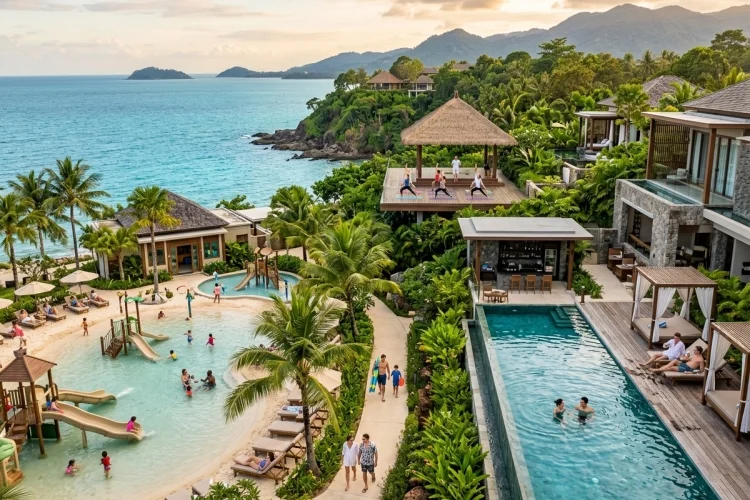
Resort amenities become expensive very quickly. Every pool needs maintenance, every restaurant needs staff, and every recreation facility consumes land that could have another commercial use.
The answer is not necessarily offering less-it is offering the right things to the right guests.
Designing Resort Amenities around customer segments and expected stay duration allows developers to create a smarter mix of facilities, experiences, and flexible spaces.
A short romantic getaway and a ten-night family vacation generate very different daily routines, so a resort designed around both should reflect those differences from the beginning.
Build a Segment-and-Stay Matrix First
Before deciding how large the spa or kids’ club should be, resort planners can create a simple matrix.
One axis represents guest segments: couples, families, multigenerational groups, solo travelers, wellness guests, groups, or destination-event visitors. The other represents likely length of stay.
This quickly reveals different priorities.
A couple staying two nights may value a strong pool, destination dining, sunset experiences, and one memorable spa visit.
A family staying seven nights may prioritize activity variety, multiple restaurants, laundry access, children’s programming, and spaces where parents and children can spend time independently.
Hotel amenity research has found that expectations and actual usage can differ according to travel purpose, property type, and length of stay.
The implication is simple: amenity demand is not universal.
Understand That Longer Stays Change Daily Behavior
Average length of stay is much more than a rooms metric.
It should influence the physical and operational program of a destination.
The 2025 Bali Hotel & Branded Residences Report from Horwath HTL and the Bali Hotel Association illustrates how strongly stay patterns can vary even inside one resort market.
In 2024, average stays were close to four days in Legian and Tanjung Benoa, while Ubud averaged about 2.7 days and Jimbaran/Uluwatu roughly 2.8 days.
Those differences can affect amenity economics.
Longer stays increase the opportunity for guests to explore secondary restaurants, book multiple experiences, use laundry services, visit the spa, or join organized excursions.
They also increase the risk of boredom.
The resort needs enough variety to make day four feel different from day one.
Design a Strong Core Before Adding Specialist Amenities
Most resorts need a core set of facilities that appeal to broad demand.
That might include an attractive pool, comfortable fitness space, reliable food and beverage, social seating, landscape experiences, and basic recreation.
Specialist facilities should come later.
A padel center, surf school, large thermal spa, water park, championship golf course, or extensive kids’ facility only makes sense when demand supports the capital and operatonal cost.
Research on hospitality amenities consistently warns that facilities guests do not actually use add cost without creating equivalent experience value.
A 2025 review of accommodation amenities similarly noted that hotel research has found positive guest effects from amenities, but also substantial variation in actual usage.
This makes prioritization important.
Every amenity does not need to serve everybody, but every major investment should have a clearly identified customer.
Make Multigenerational Resorts Work for Everyone
Family travel is becoming more diverse than the traditional parents-plus-young-children model.
Hilton’s 2026 Asia Pacific research found that 60% of respondents had taken or were planning a skip-generation trip, while nearly half of families travel with at least three generations annually.
For resort planning, this introduces several competing needs.
Grandparents may prefer accessible routes, shaded seating, calm restaurants, and wellness facilities. Children need recreation and play, while parents may want privacy or social experiences.
The solution is not forcing everyone into one enormous family zone.
Instead, planners can create overlapping environments.
A central pool might provide family activity while a quieter garden edge gives older guests somewhere to relax. Dining can include flexible tables for large parties alongside smaller spaces for couples.
Good multigenerational planning creates togetherness by choice rather than constant proximity.
Use Flexible Spaces to Support Longer Stays
Building more facilities is not the only way to create more variety.
Flexible programming can make one space perform several jobs.
A beach pavilion could host breakfast yoga, daytime water-sports preparation, afternoon workshops, and evening dining. A lawn might support children’s activities one day and an outdoor cinema the next.
This approach improves space utilisation without making the resort feel repetitive.
Flexibility is particularly valuable when guest mix changes seasonally.
During school holidays, activity spaces can focus on families. In quieter periods, those same areas might support couples, wellness retreats, corporate groups, or local events.
Furniture, storage, lighting, utility access, and acoustic design should support those transitions.
An inflexible amenity might be popular for six weeks each year. A flexible one can generate value far more consistently.
Plan Dining Around Stay Duration
Food becomes increasingly important as stays become longer.
A two-night visitor might happily eat at the same breakfast venue twice. Someone staying ten nights will notice repetition much faster.
This does not mean every resort needs ten restaurants.
Variation can come through menus, pop-ups, themed nights, destination dining, pool service, private meals, and rotating local concepts.
The Boston Hospitality Review study found differences between expected and actual use of hotel restaurants and in-room dining, with usage patterns also varying according to length of stay and hotel context.
Resort planners should therefore consider dining capacity as a network.
Where will families eat quickly? Where will couples spend on premium dinners? What happens when guests want something casual after several days of formal dining?
The best mix reduces the temptation to leave the resort simply because guests want variety.
Connect Amenities With Total Guest Spending
Amenity economics become much clearer when resorts track the full stay rather than individual transactions.
STR defines total revenue as income generated across rooms, food and beverage, spa, golf, parking, other operated departments, and miscellaneous sources. TRevPAR then measures that total against available rooms.
For resorts, another useful concept is TrevPOR—total operating revenue divided by occupied rooms.
These measures help reveal whether amenity-rich properties are capturing more spending from each guest.
A kids’ club might generate little direct revenue but create time for parents to visit the spa. Tennis facilities may encourage longer stays, which then produce more restaurant spending.
A strong amenity creates ripples.
Management should measure those connections before concluding that a low-revenue facility is underperforming.
Match Wellness Capacity With Real Demand
Wellness is one area where resorts can easily overbuild.
CBRE’s analysis of 297 U.S. hotels with self-operated spas found that resort spas generated an average of $6,539 per available room in 2024. Luxury properties averaged $9,847.
That demonstrates meaningful revenue potential, but capacity matters.
Too few treatment rooms can create lost sales during peaks. Too many can leave valuable space empty while staffing and maintanance costs continue.
Stay duration changes the opportunity as well.
Weekend visitors may book a massage before arrival. Seven-night guests have more time for thermal experiences, fitness programs, repeated treatments, or deeper wellness journeys.
Rather than simply asking how big the spa should be, planners should ask when each segment will use it and how many visits each stay might realistically generate.
Track Amenity Performance by Segment
Once the resort opens, the original planning assumptions should be tested.
Management can measure participation rate, revenue per user, cost per user, space productivity, satisfaction, and repeat usage.
Then the data should be segmented.
A pool might show 50% overall utilization but nearly 80% among families and only 20% among couples. That tells management much more than the headline figure.
Length of stay should also be included.
Do guests staying five nights use the gym twice as often as weekend guests? Does restaurant diversity matter more after night three? Do longer-stay families participate in paid activities later in their trip?
Those insights can influence everything from scheduling to future renovation.
Amenity strategy becomes much smarter when actual behaviour continuously feeds back into design and operations.
Designing Resort Amenities around guest segments and stay duration helps resorts spend capital where it creates the most value.
Short stays need immediate impact, while longer vacations demand variety, flexibility, and deeper programming.
Create a strong core, use adaptable spaces, and measure utilization by customer type after opening. Instead of asking how many amenities a resort needs, ask which experiences make each guest want to stay-and spend-longer.