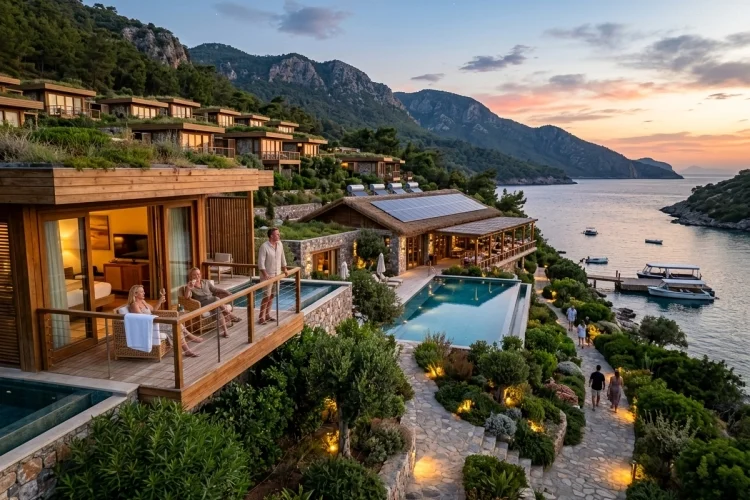
Sustainability becomes much harder when the product being sold is indulgence. Resort guests expect generous spaces, swimming pools, spas, air-conditioning, beautiful landscaping, destination dining, and highly responsive service.
Yet those expectations do not automatically make low-carbon hospitality impossible. Designing Low-Carbon Resorts means finding smarter ways to deliver the same emotional outcomes with fewer emissions.
Instead of simply removing amenities, architects and operators can rethink how spaces are cooled, how guests move, which materials are used, where food comes from, and how nature becomes part of the experience.
Define What Guests Actually Value
A useful starting point is separating luxury from resource consumption.
Guests rarely travel because they desperately want a larger electricity bill. They want comfort, privacy, memorable views, excellent service, beautiful surroundings, and a sense of escape.
Those outcomes can often be delivered with lower-carbon solutions.
A shaded terrace overlooking the sea may feel more luxurious than a sealed indoor lounge.
A locally crafted timber interior can feel more distinctive than an imported material palette. Quiet electric transportation may create a better resort atmosphere than noisy fuel-powered buggies.
WATG describes modern hospitality design as a balance between guest experience, environmental responsibility, cultural context, operational needs, and long-term financial viability.
The objective is not less hospitality.
It is smarter hospitality.
Use Passive Design to Create Comfortable Luxury
Passive design can reduce the carbon required for thermal comfort.
Architects can orient buildings around solar exposure, prevailing wind, shade, vegetation, and topography. Deep roofs, courtyards, breezeways, screens, and protected terraces can create comfortable semi-outdoor spaces.
AYANA Segara Bali offers a useful example. Its 205-key design uses open-air corridors, native planting, locally sourced materials, and guestroom blocks arranged around courtyards while responding to its cliff-top setting and ocean views.
None of those strategies requires guests to think about carbon.
They experience views, breeze, landscape, and a stronger connection with Bali.
That is why passive architecture can be powerful: environmental performance and experiential quality can come from the same design decision.
Combine Efficiency With Clean Energy
Even well-designed resorts still need electricity.
Guestrooms require lighting and cooling. Kitchens need refrigeration and cooking equipment. Pumps serve pools and water systems. Spas and laundries can also create substantial loads.
The first step is reducing those loads through efficient systems.
The next is supplying more of the remaining demand with low-carbon energy where technically and financially practical.
WTTC’s Net Zero Roadmap for Travel & Tourism provides a sector-level framework for decarbonization toward net zero by 2050 and identifies the need for coordinated action across tourism businesses.
For an individual resort, that might mean solar photovoltaics, renewable electricity procurement, heat pumps, solar hot water, battery storage, or other site-specific solutions.
The right combination depends on climate, grid conditions, land availability, and operating patterns.
Low-carbon design should be specific, not generic.
Reduce Carbon Hidden Inside the Building
Operating energy gets most of the attention because it arrives as a utility bill.
Embodied carbon is easier to overlook.
WATG’s whole-life carbon work emphasizes that meaningful carbon assessment needs to include both operational and embodied impacts across a project’s lifecycle.
For resorts, that can affect everything from foundations to furniture.
Reducing excessive structural spans may reduce concrete or steel quantities. Local materials can sometimes shorten transportation routes. Recycled or biogenic products can lower embodied impacts where suitable.
Durability is also important.
Replacing beautiful but fragile finishes every few years creates repeated material consumption, freight, labor, and waste.
A lower-carbon specification should survive actual hotel use.
That includes luggage impacts, cleaning chemicals, sunlight, humidity, salt air, and constant guest turnover.
Design Water and Energy Together
Water consumption also has a carbon footprint.
Pumping, heating, treating, and moving water all require energy. Resorts with pools, extensive landscaping, hot showers, spas, and laundry operations can therefore benefit from integrated water planning.
USGBC reports that green buildings use around 30% less indoor water on average than conventional buildings. Its hospitality guidance points to water efficiency as one of the major opportunities for hotels.
Low-flow fixtures are only the beginning.
Climate-appropriate planting can reduce irrigation. Heat recovery can capture energy from systems that would otherwise waste it. Treated wastewater can sometimes serve landscaping or other non-potable needs where local regulations allow.
The important idea is connection.
Saving hot water saves both water and the energy required to heat it.
That improves carbon efficency without reducing the guest’s actual shower experience.
Turn Nature Into an Amenity
Low-carbon resorts often have one major advantage: nature can replace some forms of built extravagance.
A restored wetland, coastal landscape, native forest, desert garden, or protected reef can become a defining guest experience.
WATG’s research on sustainable hospitality near wetlands highlights strategies such as ecological planning, native planting, biophilic design, water-sensitive landscape architecture, and measurable biodiversity improvement.
This creates an interesting commercial opportunity.
Instead of investing endlessly in constructed attractions, resorts can make the existing environment more accessible and meaningful through boardwalks, guided experiences, observation areas, interpretive programs, and thoughtful landscape design.
Nature provides experience without needing to be mechanically cooled or replaced every renovation cycle.
Protecting it can therefore become both an ecological and asset strategy.
Make Low-Carbon Mobility Feel Premium
Guest movement is another area where carbon and experience can align.
Large resorts often rely on internal vehicles, boats, transfers, and extensive service fleets.
Electric buggies and shuttles can reduce local emissions and noise. Walkable planning can reduce vehicle demand entirely. Shaded pathways, bicycles, and conveniently placed amenities can make low-carbon movement feel intentional instead of inconvenient.
The Red Sea master plan demonstrates how mobility, infrastructure, architecture, ecology, conservation, and guest experience can be planned together across a large tourism destination.
This integrated approach matters.
If a low-carbon mobility strategy makes guests wait twenty minutes for transport, they will perceive it as poor service.
If electric vehicles arrive quickly and quietly, sustainability may actually improve the luxury experience.
Measure Carbon Without Making Guests Do the Work
A resort cannot manage emissions properly without knowing where they come from.
The Sustainable Hospitality Alliance’s HCMI methodology allows hotels to calculate total carbon emissions, carbon per occupied room, meeting-space emissions, and the share of renewable energy in consumption. It is used by more than 30,000 hotels globally.
That data should mostly work behind the scenes.
Operators can track progress, compare periods, identify abnormal usage, and target investments without making every guest responsible for managing the hotel’s systems.
Guests can still be invited to participate through optional linen reuse, responsible excursions, lower-carbon menus, or refill programs.
But the biggest reductions should come from how the asset is designed and operated.
Sustainability works better when the building carries most of the burden.
Use Sustainability to Strengthen the Business Case
Lower-carbon development is not only about emissions.
IFC’s work on sustainable hotels argues that resource-efficient properties can benefit from utility savings, greater investment resilience, consumer preferences, regulatory incentives, and long-term property value.
That makes sustainability relevant to developers, operators, lenders, and owners.
A low-carbon system that cuts electricity consumption can reduce operating costs. Durable local materials may lower replacement needs. Water conservation can reduce exposure in water-stressed destinations.
The benefits may not always appear under one budget line.
That is why developers need lifecycle models rather than evaluating every measure only by its upfront price.
The best low-carbon resort strategies create both experiential and commerical value.
Designing Low-Carbon Resorts is ultimately about delivering luxury with less waste, not less pleasure.
Passive architecture, efficient systems, low-impact materials, thoughtful water use, natural amenities, and cleaner mobility can reduce emissions while improving comfort and identity.
Start by defining what guests truly value, then design the lowest-carbon way to deliver it. Sustainability becomes much easier when experience and environmental performance solve the same problem.