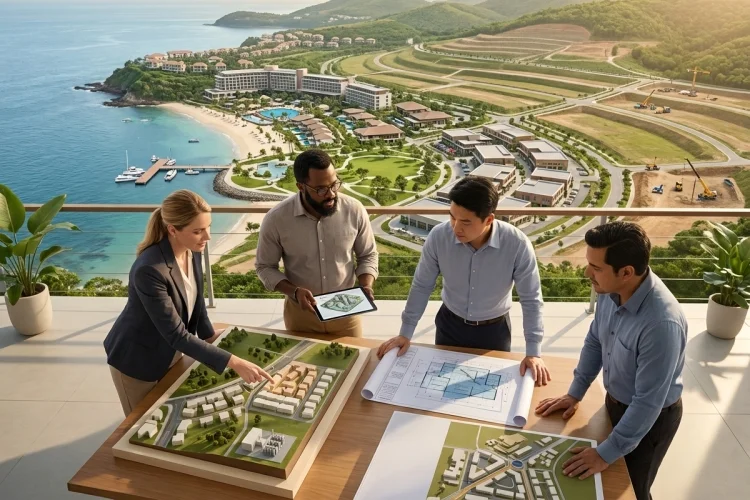
The most successful resort master plan is not necessarily the one that predicts the future perfectly. It is the one that can survive when those predictions turn out to be wrong.
Designing Mixed-Use Resort Plans means creating a destination where hotels, residences, restaurants, shops, wellness spaces, and entertainment can evolve as demand changes.
Instead of optimizing everything around opening year, planners increasingly consider how assets might perform ten, twenty, or thirty years later.
Commercial flexibility gives owners more options, reduces dependence on a single revenue stream, and makes expensive real estate easier to reposition.
Diversify the Resort’s Revenue Engine
Traditional resorts rely heavily on guestrooms and food and beverage. Mixed-use destinations can create a much broader revenue structure.
A development might combine hotel income with branded residence sales, management fees, retail leases, club memberships, spa revenue, events, and recreational activities.
This diversification matters because different components often perform differently during economic cycles.
JLL’s Global Hotel Investment Outlook 2025 highlighted the continued expansion of branded residences and projected that the sector could more than double in size by 2030, with nearly 800 new branded residential projects expected globally.
For resort planners, that growth illustrates why flexible land allocation can be useful. A parcel originally reserved for additional hotel rooms might become more valuable as residential development if ownership demand strengthens.
Give Each Component More Than One Role
Successful mixed-use spaces often perform several functions.
A hotel lobby might operate as a guest arrival area in the morning, a coworking environment during the day, and a social lounge at night. An event lawn can accommodate weddings, festivals, corporate gatherings, and community activities.
Restaurants can serve hotel guests, residents, and outside visitors.
This reduces the risk of creating expensive spaces that remain empty for much of the day.
JLL argues that hospitality brands have increasingly explored new verticals and services partly to diversify revenue and deepen relationships with customers beyond the traditional hotel stay.
That mindset can shape master planning from the beginning.
Instead of asking what a space does today, planners can ask how many different ways it could earn money over its lifecycle.
Plan Commercial Uses Around Changing Demand
Retail is one of the easiest areas to overbuild.
A master plan might initially show rows of boutiques because retail makes a destination look complete on paper. But stores need enough foot traffic, visibility, accessibility, and customer spending to survive.
Urban Land Institute has warned that mixed-use projects cannot succeed simply by adding retail to a development without considering whether the location genuinely supports it.
For resorts, this means commercial space should match realistic demand.
A small collection of sucessful restaurants, convenience retail, experiential shops, and wellness concepts may perform better than a large shopping district with weak occupancy.
Flexible leasing spaces can also evolve as preferences change.
Three small shops, for example, might later be combined into one larger restaurant or fitness concept if partitions and utilities are designed appropriately.
Use Branded Residences Strategically
Branded residences have become an increasingly important part of mixed-use hospitality.
They can create development proceeds, broaden the customer base, and help finance shared amenities. Owners may also contribute to service ecosystems that include restaurants, fitness facilities, housekeeping, concierge services, and resort activities.
However, residences should not simply be added because the format is popular.
They need privacy, access, parking, security, service circulation, and clear relationships with hotel amenities.
JLL notes that branded residences allow hospitality companies to extend their brand relationship from temporary stays into ownership.
The strongest resort layouts allow residential areas to feel exclusive while still supporting the wider destination economically.
Protect the Hotel Experience
Sharing amenities can improve economics, but excessive sharing may create congestion.
Planners should determine which facilities remain hotel-only, which are residential, and which operate as shared commercial assets.
Design for Conversion Instead of Demolition
One of the strongest forms of long-term flexibility is the ability to change a building’s purpose without rebuilding it entirely.
Structural grids, floor-to-floor heights, access, natural light, mechanical systems, and circulation can influence whether conversion is practical.
A commercial building might eventually become offices, wellness suites, serviced accomodation, or another hospitality use.
Urban Land Institute discussions around adaptability emphasize that changing social, transportation, and economic patterns make flexibility increasingly important in mixed-use environments.
Conversion will never be completely frictionless. However, avoiding overly specialized layouts can reduce future costs.
That matters because resort trends can change far faster than major buildings reach the end of their physical life.
Create Infrastructure That Supports Expansion
A flexible resort needs an infrastructure backbone capable of supporting future growth.
Power, water, wastewater, roads, parking, digital systems, kitchens, storage, waste handling, and employee facilities all need to be considered beyond phase one.
The challenge is balancing future capacity with today’s investment budget.
Overbuilding everything increases capital costs. Underbuilding can make future phases much more expensive.
WATG describes strong hospitality master planning as a balance between aesthetics, sustainability, operational efficiency, and financial viability.
One practical approach is to establish expandable utility corridors and strategically located connection points. Later phases can then connect without major disruption to existing guest areas.
Future maintanance access should receive similar attention.
Make Phasing Part of the Business Model
Phasing should not be viewed simply as a construction schedule.
It is also a commercial strategy.
HVS argues that mixed-use hospitality works best when design, operations, and recurring revenue are aligned as one ecosystem rather than developed independently.
An initial resort phase can establish the brand and destination. Residential sales may then help support the next investment cycle, while later retail or entertainment components benefit from a larger established customer base.
This reduces the need to predict every source of demand from day one.
It also gives developers time to observe how guests and residents actually use the property before committing to later phases.
A flexible plan therefore becomes a learning system rather than a fixed blueprint.
Keep the Master Plan Commercially Alive
Master plans should be reviewed as market conditions change.
A land parcel that made sense for retail five years ago may now be better suited to villas. A traditional meeting facility might benefit from conversion into wellness, social, or flexible event space.
ULI’s recent work on evolving mixed-use districts highlights how rising costs, demographic change, and shifts in how people work and gather continue to reshape development strategies.
Regular review allows the plan to respond without losing its overall identity.
The best mixed-use resort strategy maintains strong design principles while allowing individual components to change when the business case changes.
Designing Mixed-Use Resort Plans for lasting value requires more than an attractive opening-day vision.
Diversified revenue, convertible spaces, expandable infrastructure, careful residential integration, and flexible phasing help resorts adapt as markets evolve.
Rather than treating the master plan as permanent, owners should use it as a long-term commercial framework-one that can change while keeping the destination coherent, efficient, and profitable.