Hotels can lose money even when every department appears to be doing its job.
The problem is that cost leakage often lives between processes: an invoice nobody checks closely, inventory ordered twice, a complimentary item never recorded, or equipment consuming more power than expected.
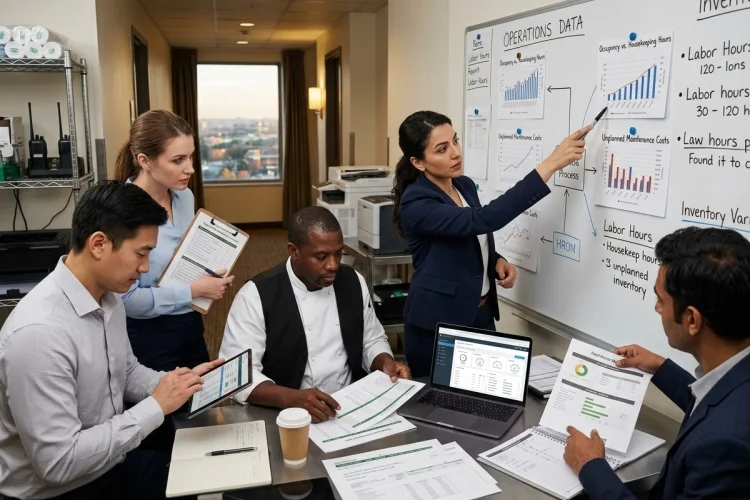
Knowing How Hotel Teams Identify Cost Leakage requires moving from broad expense control to detailed operational observation.
Instead of asking departments to “cut 5%,” good managers trace where money enters a workflow, how resources are used, and where cost increases without producing additional guest value or revenue.
Map the Process Before Blaming the Budget
When an expense rises, the instinct is often to tell the department manager to spend less.
That may treat the symptom rather than the cause.
Process mapping gives teams a better starting point. Choose an operating activity and follow it from beginning to end.
For purchasing, that means request, approval, purchase order, delivery, storage, departmental issue, usage, and eventual disposal.
For housekeeping supplies, teams can trace how amenities move from storage to floor pantries and guestrooms.
Every handoff creates a potential leakage point.
HVS argues that hotel profitability in 2026 increasingly depends on operational realignment and benchmarking because elevated operating costs are becoming structural rather than temporary.
That makes understanding the actual workflow more useful than applying broad reductions with no operational diagnosis.
Compare Cost per Unit of Activity
Dollar totals become much more useful when they have context.
If laundry expenses increase 8%, management needs to know whether occupied rooms also increased 8%.
If food purchasing rises 12%, did restaurant covers rise by the same amount?
HVS’s latest operating-data framework compares hotel expenses using percent of revenue, dollars per available room, and dollars per occupied room, illustrating why normalized benchmarks can reveal patterns hidden by total dollars alone.
Hotels can create similar internal measures.
Examples include housekeeping supplies per occupied room, breakfast cost per cover, laundry cost per occupied room, maintenance expense per available room, and utilities per occupied room.
The objective is not creating dozens of reports.
A few meaningful ratios can expose inefficency much faster than a long spreadsheet full of totals.
Reconcile What Was Bought With What Was Used
Inventory leakage often occurs because purchasing and consumption are viewed separately.
The hotel knows what it bought. A department knows what remains in storage. Few people consistently reconcile the two with expected usage.
Suppose the hotel purchased 1,200 bottles of wine, recorded sales equivalent to 850 bottles, and currently holds 250 bottles.
There are 100 bottles that require an explanation.
They may have been used for complimentary service, breakage, events, staff training, incorrect POS postings, or theft.
The same logic works for linen, guest amenities, cleaning chemicals, minibar products, maintenance parts, and kitchen ingredients.
HFTP emphasizes continuous procurement controls because many small purchasing and supply-chain inefficiencies can compound into meaningful costs over time.
Regular reconciliation turns invisible losses into identifiable operational questions.
Make Food Waste a Daily Operating Metric
Hotel kitchens often measure food cost but spend less time measuring what goes into the bin.
That leaves an important gap.
UNEP estimated that the food-service sector generated around 290 million tonnes of food waste in 2022 and noted that actual waste may be underestimated because measurement remains inconsistent across hotels and restaurants.
The simplest improvement is weighing and categorizing discarded food.
Separate Production Problems From Guest Behavior
Preparation waste might indicate poor knife skills or product specifications.
Spoilage may indicate over-ordering or weak storage rotation.
Buffet leftovers usually point toward forecasting and batch-production problems.
Plate waste can indicate oversized portions or menu items guests do not enjoy.
Winnow’s 2025/26 impact report says hospitality businesses using its systems collectively save more than $100 million annually in food costs, while its research indicates many operators underestimate how much food they actually waste.
Measurement changes a vague issue into something the culinary team can manage.
A kitchen cannot control what it does not meassure.
Review Vendor Prices and Contract Compliance
Cost leakage can happen even when a hotel has negotiated good supplier agreements.
Employees may purchase from non-approved suppliers because ordering is easier. Departments may choose premium substitutes unnecessarily, miss volume discounts, or pay rush-delivery charges because ordering happened too late.
Hotels should periodically compare invoice pricing against negotiated contracts.
Management can also review freight, delivery charges, minimum-order fees, and price changes that appear quietly over time.
A 2% increase on one small purchase is insignificant.
A 2% increase across high-volume food, linen, cleaning, and operating supplies can become substantial.
HFTP’s procurement guidance highlights the value of continuous cost controls because supply-chain improvements often arrive through many incremental gains rather than a single dramatic saving.
That means vendor management should be a recurrng process, not an annual negotiation exercise.
Use Utility Data to Spot Operational Anomalies
Energy bills should not be reviewed only as accounting expenses.
They contain information about how the building is operating.
ENERGY STAR notes that hotels and motels in the United States spend roughly 6% of operating costs on energy and face unusually complex energy requirements because they run guestrooms, public areas, kitchens, laundries, pools, and other facilities around the clock.
Hotels can compare consumption by month, occupancy level, weather conditions, and operational activity.
If water usage suddenly increases while occupancy remains stable, the hotel may have a leak.
If electricity consumption rises after HVAC maintenance, equipment may have been configured incorrectly.
Submetering can provide even greater detail for large properties.
Utilities become easier to manage when engineering and finance review the same data instead of treating energy as a fixed expense nobody owns.
Find Revenue Leakage Hiding Inside Cost Control
Not every leak appears as an expense.
Sometimes hotels lose profit because revenue-producing services are provided but never properly charged.
Examples include unposted minibar consumption, waived parking fees, complimentary upgrades without authorization, missing banquet charges, late checkouts that are never billed, or meeting-room equipment not appearing on the final invoice.
The solution is not charging guests unexpectedly.
It is making sure the hotel’s pricing policies, service delivery, and billing processes match.
Teams can compare operational records with posted revenue.
If the parking system shows 300 paid vehicle entries while the PMS records only 220 parking charges, the difference deserves investigation.
Small billing gaps can become significant when repeated every day.
This type of reconcilliation should be part of cost-leakage analysis because missed revenue damages profit just as surely as excess spending.
Create a Daily Cost-Leakage Routine
Hotels do not need a large consulting project to begin finding leakage.
Department heads can identify a small number of daily and weekly exception metrics.
Housekeeping might monitor labor hours, linen usage, and amenities per occupied room.
F&B can track food cost, waste, voids, discounts, and average check.
Engineering can review utilities, open work orders, and recurring equipment failures.
Finance and procurement can monitor unusual invoices, vendor price changes, and purchases outside approved agreements.
The purpose is exception management.
If everything is within normal tolerance, the team keeps operating. When something moves unexpectedly, managers investigate immediately.
That is much more effective than discovering three months later that an avoidable cost has quietly become standard practice.
Understanding How Hotel Teams Identify Cost Leakage starts with connecting financial numbers to the processes that create them.
Cost-per-unit benchmarks, inventory reconciliation, food-waste tracking, vendor controls, utility analysis, and billing reviews make hidden losses visible.
Pick one recurring operating process this week, map every handoff, and investigate where money or resources disappear without improving revenue or guest experience.